
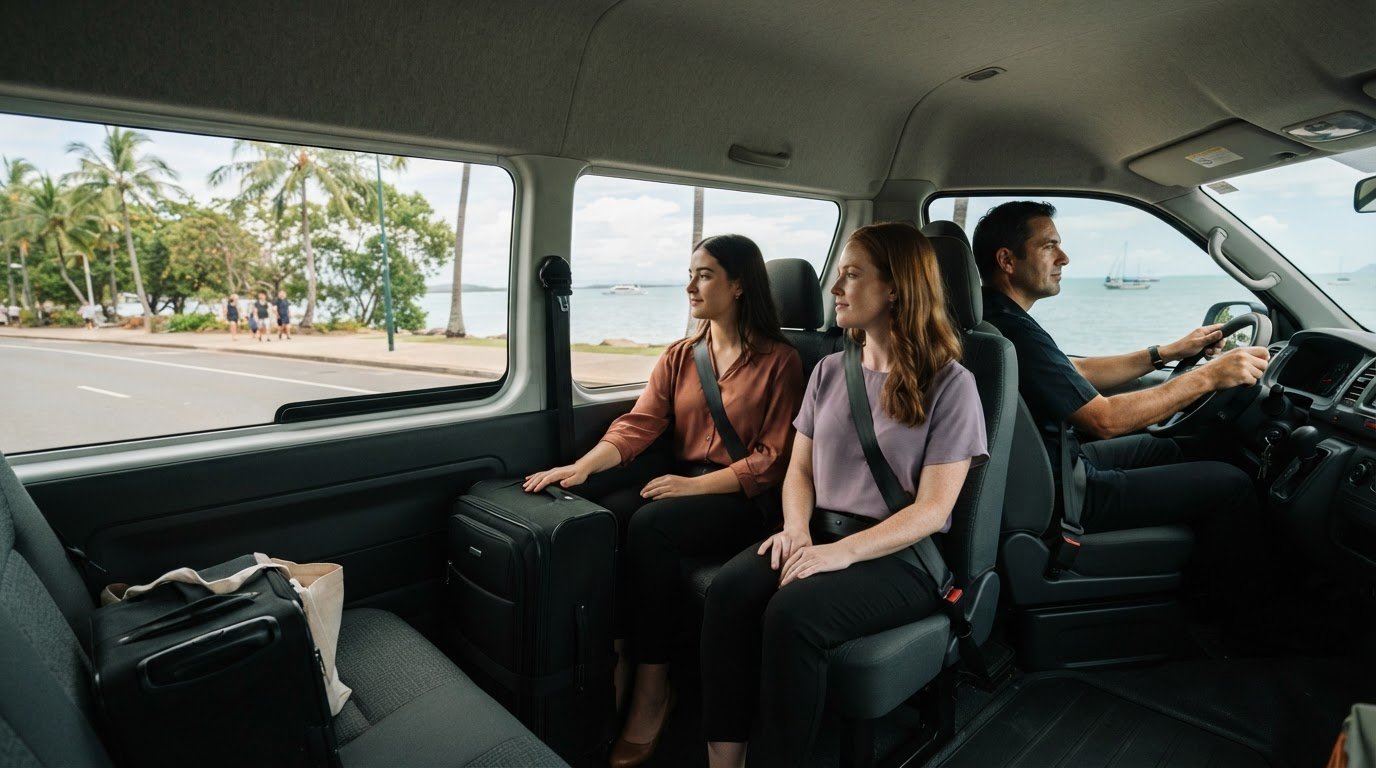
Your conference group lands on the morning of the event. Do you want delegates coordinating separate rides, or travelling together with a professional driver and a planned itinerary? Chartered private passenger vans for hire in Australia can suit a one-day booking, giving your group a dedicated vehicle for event transfers without the need to drive yourselves.
When the schedule is tight, dependable transport matters. A chauffeured vehicle can help keep airport arrivals, accommodation pickups and conference travel organised. The right vehicle and itinerary depend on your group’s needs, journey and luggage, so include those details when requesting a quote.
This guide explains how one-day charters work, what to include when requesting a quote, and how chauffeured vans can support corporate events and conferences. You’ll also learn what to consider when planning group transfers, so you can choose an option that keeps the day running smoothly.
Key Takeaways
- A one-day charter can bring conference transfers together under a planned itinerary, with pickup points and timings organised around your event.
- A useful quote request sets out your group’s travel schedule, passenger needs and luggage requirements.
- Choose a chauffeured van with seating and cargo space suited to your group, rather than judging fit by passenger numbers alone.
- Driver credentials, vehicle safety and appropriate insurance are key considerations when arranging passenger transport.
- For travel around Far North Queensland, explore transfer options for Cairns Airport, Palm Cove, the Atherton Tablelands and Mission Beach.
Group transfers for conferences and events
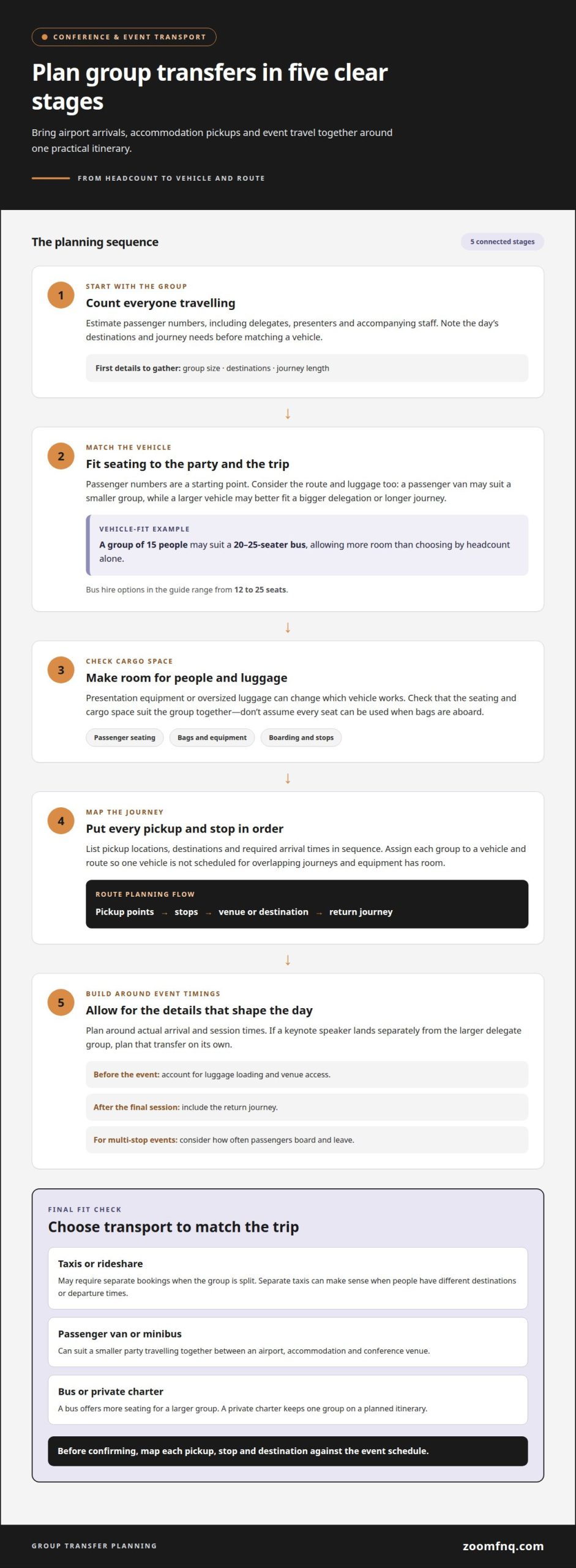
For a conference in Cairns or a corporate retreat, coordinated group transport can keep airport transfers, accommodation pickups and event arrivals on one schedule. Start with passenger numbers, luggage and the day’s destinations, then match vehicles and seating to the itinerary.
Group size and vehicle fit
Passenger numbers guide the vehicle size, but the itinerary and luggage matter too. A group of 15 people may suit a 20-25-seater bus, which allows more room than choosing solely by headcount. For larger groups or extended journeys, bus hire options range from 12 to 25 seats. Include delegates, presenters and accompanying staff when estimating the group.
Next, consider how much cargo space the group needs. A conference party carrying presentation equipment or oversized luggage may need more room than a group travelling with small bags. Check that seating and luggage space work together, rather than assuming every seat can be used when bags are aboard. For a multi-stop event, also consider how often passengers will board and leave.
Van and bus hire options
A passenger van can suit a smaller group travelling together between an airport, accommodation and conference venue. A larger vehicle may be a better fit when more attendees need transport on the same route or the itinerary involves longer travel. For example, a retreat group travelling to a regional location may prioritise seating and luggage space over a compact vehicle.
When planning, list pickup locations, destinations and required arrival times in order. Then assign each group to a vehicle and route. This helps avoid scheduling one vehicle for overlapping journeys or leaving too little room for equipment. Planning around these details makes the transport schedule easier to manage.
Conference and event transport uses
Group transport can cover airport transfers for delegates, accommodation-to-venue trips, off-site dinners and travel between conference locations. For a corporate event, a shared itinerary gives organisers a clear view of which group travels where and when. It can also help keep presenters and attendees together when they share an arrival or departure window.
Build the schedule around actual event timings. For instance, plan separately for an early keynote speaker if their flight lands at a different time from the larger delegate group. Include luggage loading, venue access and the return journey after the final session. These details make the transport plan practical, rather than relying on a single pickup time.
Comparing group transport choices
How do private charters compare with taxis, rideshare, minibuses and buses? A private charter keeps one group on a planned itinerary, while taxis or rideshare may require separate bookings for split groups. A minibus or passenger van can suit a smaller party; a bus offers more seating for a larger group.
Choose by matching the vehicle to passenger numbers, schedule and luggage. Separate taxis can make sense when people have different destinations or departure times. A chartered van can bring a defined group together for airport transfers and event travel, while a larger vehicle may better suit a bigger delegation. Before confirming the plan, map each pickup, stop and destination against the event schedule.
Booking details and confirmation
A well-prepared booking records the journey, passenger needs and agreed service details. Clear information before confirmation helps you understand what the booking covers.
Booking support
The booking details should describe the transport arranged, including pickup points, destinations, scheduled times and any planned stops. For an airport journey, provide flight details and the arrival terminal where known. For city travel in Melbourne, include the venue and the required arrival time. These details help define the driving schedule and the service being arranged.
Customer service matters when plans change or the itinerary has several stages. The ACCC says vehicle-hire businesses should provide upfront and accurate information so consumers can make informed decisions. A clear booking conversation should explain what the booking includes and how updates to the journey are handled. You can submit a transfer booking with your route and travel details.
Booking documents and operator requirements
Keep the booking confirmation with the itinerary and any correspondence about changes. It should identify pickup and drop-off locations, travel date, passenger numbers, luggage needs and the contact person coordinating the group. For an airport transfer, flight information helps connect the booking to the correct arrival. For a regional trip, list each stop in sequence.
Ask for the operator’s booking terms and the documents relevant to the vehicle and service. Passenger transport requirements can depend on the vehicle and the state or territory where it operates, so don’t assume every van has identical requirements. The booking record should make the planned service clear, including which party handles updates and how the drivers receive itinerary changes.
Hire policies and booking terms
What are the cancellation, waiting-time and luggage policies for Australian van hire? These terms are set by the operator and should be explained in the booking conditions, including relevant notice periods, waiting arrangements and luggage allowances. Read them alongside the itinerary, not as separate fine print.
Wheelchair-accessible charter vans depend on vehicle configuration and the passenger’s access requirements. Include mobility aid details, boarding needs, passenger numbers and the route in your booking request so the transport arrangement can account for them. What should you check before hiring in Sydney, Melbourne, Brisbane, Perth or regional Australia? Confirm the route, pickup access, timing, luggage and applicable booking terms for that location.
Before accepting a booking, compare its written details with your planned journey. An airport transfer may need different timing details from a regional trip with several stops. Confirm that passenger numbers, pickup address, destination, luggage and access requirements are recorded accurately. If the event schedule changes, share the revised itinerary promptly so the operator can assess its effect on the booking.
Chauffeured people movers and private passenger vans
A chauffeured vehicle suits passengers who want a professional driver and a planned journey. When comparing chartered private passenger vans for hire in Australia, match the vehicle to your seating and luggage needs.
Chauffeured people movers
People movers typically seat 7 or 8 passengers, making them a practical option for a family, small work team or airport party. Match the passenger count to the luggage, rather than assuming every seat can be used alongside every bag. For example, a Kia Carnival or similar people mover can fit two large bags and two small bags.
For an airport pickup, consider how many passengers will board together and what they are carrying. A group with several suitcases may need a different arrangement from colleagues travelling with hand luggage. Seating comfort also matters on a longer journey, particularly between an airport, accommodation and an event venue.
People movers can offer practical features such as individual climate control, extra legroom and headspace, and sliding doors. These details can make boarding easier when passengers are carrying bags or travelling with children. If child restraints are needed, include that requirement in the booking details.
Private passenger vans
A private passenger van is reserved for your group and driven by a professional, rather than collected as a self-drive rental. Chartered private passenger vans for hire in Australia can suit a team travelling on the same itinerary, such as a conference group moving between an airport and accommodation. Before choosing, consider passenger seating, luggage space and each planned stop.
For a work trip, list the group’s pickup point, destination and any intermediate stops. Then match the vehicle arrangement to those details. A spacious vehicle can help keep the group together, but luggage still affects how many passengers can travel comfortably. Include equipment, prams or other oversized luggage in your travel plan.
Customer service also shapes the experience before travel. Clear communication about the itinerary, passenger needs and pickup arrangements helps the driver follow the planned journey. For example, a group arriving on different flights may need separate pickup times rather than one shared arrival schedule.
To compare a people mover with a private van, weigh the number of passengers against the bags and the route. A 7 or 8-seater people mover may suit a compact party, while a larger group may need a different vehicle arrangement. The best fit is the one that accommodates your passengers and luggage without relying on assumptions about capacity.
For any vehicle, provide accurate passenger and luggage details when booking. Mention child restraint needs, mobility considerations and itinerary changes. Those details help shape a suitable arrangement before the journey begins, whether you’re travelling to an airport, a meeting or accommodation.
What licences and permits are required to operate a passenger charter van in Australia?
The licence required depends partly on the vehicle. Vehicles in the displayed range can be driven in Australia with a standard full driver’s licence, without a special licence. Larger vehicles may require an Australian medium rigid driving licence. For a chauffeured charter, you travel as a passenger, so the driver’s licence class is the relevant driving question.
Match the licence class to the vehicle
Start by identifying the vehicle category and the licence held by its driver. A standard passenger van and a larger vehicle may have different licence requirements. This distinction matters if a booking changes from a van to a larger vehicle, or if the group’s needs call for more seating.
For example, if you are arranging transport for colleagues and the proposed vehicle is larger than a standard van, ask for its vehicle class and the applicable driver licence class. An Australian medium rigid licence may be required to hire larger vehicles. This concerns hiring and driving the vehicle; it does not mean every charter passenger needs a special licence.
Separate driving licences from permits
A driver’s licence and an operating permit are different matters. The licence concerns the person driving a vehicle; permits relate to the authority to operate a passenger transport service. Don’t assume that a standard driver’s licence alone answers every question about a charter operation. The vehicle, service and jurisdiction all shape which requirements apply.
For an interstate itinerary, the route may pass through more than one state or territory. Identify where the service begins, where it travels and which vehicle will be used. These details help distinguish the driver’s vehicle class from any operator approvals relevant to the passenger service.
What to establish before travel
Before a corporate booking, record the vehicle type, passenger capacity and route. Then establish the driver licence class needed for that vehicle and the operating approvals relevant to the service. A booking that replaces a smaller van with a larger vehicle may need a fresh review of the driver’s licence class.
For passengers, the practical distinction is straightforward: you are not driving the charter vehicle, so your personal driver’s licence does not authorise the journey. The operator’s driver must hold the licence appropriate to the vehicle, while the operation must meet applicable passenger-service requirements. Keep these questions separate when assessing a booking.
In short, a standard full driver’s licence applies to vehicles in the displayed range, while an Australian medium rigid driving licence may be required for larger vehicles. Permit requirements concern the operator and passenger service, not the passenger’s authority to travel. Clear details about the vehicle and route make it easier to understand which requirements apply to the planned charter.
What safety standards and insurance should passengers check when booking a charter van?
A safe charter booking starts with the vehicle, driver and passenger requirements. For a corporate trip, consider how seatbelts, child restraints, luggage and insurance apply to your group and itinerary.
Vehicle condition and passenger safety
Ask how the operator maintains vehicles and handles reported faults. Before boarding, note whether the vehicle appears clean and in good working condition. Check that each passenger has a seatbelt and can use it properly. Even a spacious vehicle needs suitable seating for everyone travelling.
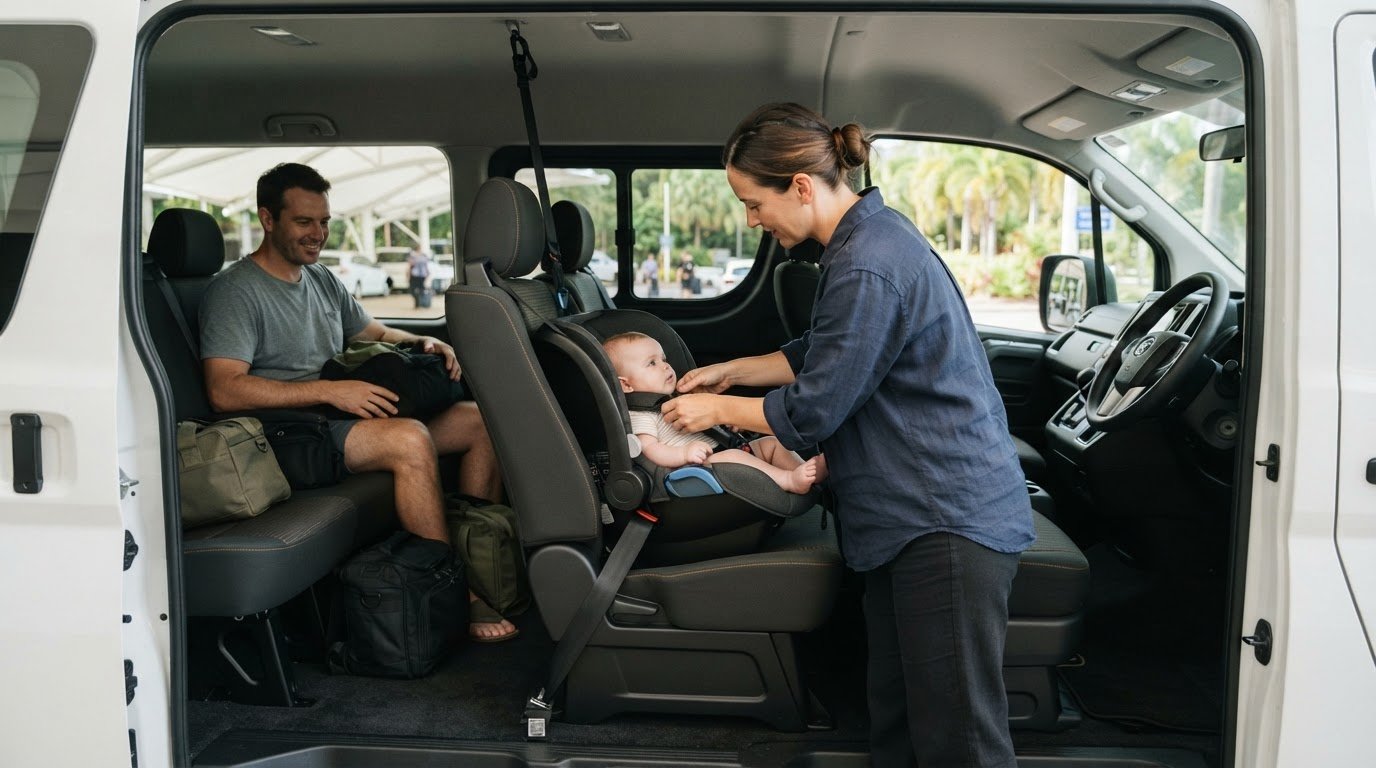
For a family booking, tell the operator if you need a child restraint, baby capsule or child car seat. Give the child’s age and size, where relevant, so the arrangement can account for the passenger. Don’t assume a restraint will be available unless you include it in the booking. The same applies to mobility needs or equipment that affects boarding.
Driver and journey arrangements
A professional driver is central to a chauffeured charter. Understand who is responsible for driving and how the itinerary will be shared with them. A journey from an airport to a conference venue, for example, may need a different route and pickup plan from a direct accommodation transfer. Clear instructions help the driver follow the agreed schedule.
Safety also depends on matching the vehicle to the trip. Consider passenger numbers, luggage and route length. A group carrying presentation equipment needs to keep the driver’s view and passenger seating unobstructed. Include stops and child restraint needs in the itinerary, rather than leaving them until pickup.
Insurance and booking records
Insurance terms differ, so ask what cover applies to the passenger charter and the booked journey. Clarify how the policy treats passenger injury, damage to the vehicle and personal belongings. Don’t assume that cover for the vehicle automatically explains every passenger or luggage situation. Ask for the relevant terms in writing before confirming the booking.
Keep the booking confirmation and insurance information with your travel records. If a corporate organiser books for colleagues, share key transport details with the group, including the pickup point and arrangements for contacting the operator. A written record can help resolve confusion about the agreed service if the itinerary changes.
For a group transfer, set out passenger numbers, luggage, child restraint requirements and the route when arranging the booking. This gives the operator practical information to plan the vehicle and journey. Arrange your transfer booking with those details ready.
Zoom FNQ
Zoom FNQ arranges private transport and small group charters nationwide across Australia. Its services include airport, hotel and resort, group and corporate transfers, as well as minibus charters. Advance booking is essential, and vehicles are available around the clock when pre-booked.
Zoom FNQ offers airport, hotel and resort, group and corporate transfers, as well as minibus charters. Share your pickup point, destination, passenger numbers, luggage and timing when arranging a booking. These details help shape the transport plan around your journey, whether you’re travelling from an airport or between destinations.
For a transfer that fits your itinerary, contact Zoom FNQ to discuss your travel plans.
Plan the next leg of your event journey
Choosing chartered private passenger vans for hire in Australia is only one part of planning a smooth event journey. The next step is to turn your travel schedule into a clear transport plan, with pickup points and destinations that work for your delegates. A well-organised itinerary can help your group move between arrival points, accommodation and event venues with less coordination on the day.
For travel around Cairns, Zoom FNQ offers Cairns Airport Transfers, Cairns City Transfers and Palm Cove Transfers. These options can help you plan local transport around a conference or corporate gathering. Share your intended route and group’s requirements when arranging your booking, so the transport plan reflects the journey you have in mind.
Ready to discuss the right arrangement for your event? Contact Zoom FNQ to discuss your transport. A considered plan is a practical start to welcoming your group.
Frequently Asked Questions
Can I book a private transfer for just one day?
Yes, you can book a private transfer for a single day. Your itinerary might cover an airport pickup, travel between accommodation and a conference venue, then a return transfer after the event. Include the travel date, pickup times, stops and expected finish time when requesting a booking. These details help shape the service around your schedule, rather than treating it as a vehicle-only rental.
Which Australian companies offer private passenger van hire with a driver?
Zoom FNQ offers Small Group Charters and Small Group Transfers for passengers seeking pre-arranged transport with a professional driver. These services suit groups that want a planned journey rather than self-drive hire. Consider whether the service suits your route, group needs and itinerary. Zoom FNQ serves Far North Queensland, so choose an option that covers your destinations.
What types and seating capacities of charter vans are available in Australia?
Australian group transport options include people movers, passenger vans, minibuses and buses. People movers typically provide comfortable seating for 7 or 8 passengers, while bus hire options can range from 12 to 25 seats. Treat these as broad vehicle categories, not a guarantee about a particular charter’s available seating. Luggage, equipment and the vehicle layout also affect how many passengers can travel comfortably together.
What details should I confirm before booking a charter van?
Confirm the travel date, pickup and drop-off locations, passenger numbers, luggage requirements and itinerary. For an event, specify whether you need one transfer or several trips. Sharing these details helps Zoom FNQ plan the service around your group’s schedule and travel needs.
How should I plan a charter van itinerary for multiple stops?
List each pickup and drop-off location, the order of stops and the expected timing for each leg. Pickup and drop-off locations shape the transport plan, including whether the trip is local or regional. Passenger numbers, luggage and specific travel needs may also affect the vehicle arrangement. Provide the complete itinerary so the transport plan accounts for the whole journey, not just one leg.
What information should I provide when booking a charter van for airport transfers, events, or group travel in Australia?
Give the operator your travel date, pickup and drop-off addresses, passenger count, luggage details and preferred timings. For an airport transfer, include the airport, flight details and arrival information. For an event, list venue locations, scheduled start and finish times, and any planned stops. Mention child restraint or accessibility requirements when relevant. A clear itinerary helps the transport plan account for the group’s needs.
Related posts

Leave a Comment