
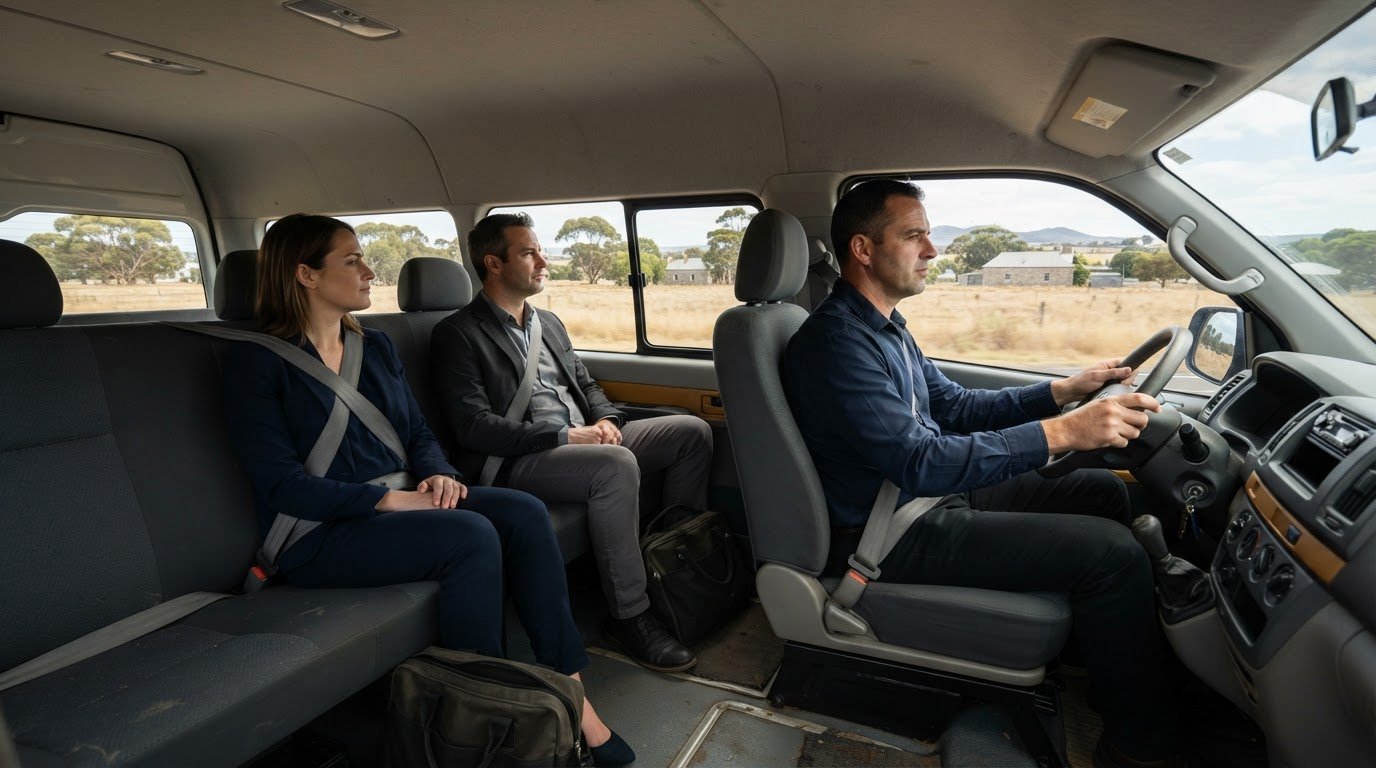
Your meeting is in regional South Australia, the schedule is tight, and arriving on time matters. Planning private transport for regional business meetings in Australia means weighing more than the route: you also need to understand what transport test results can and can’t tell you.
It’s reasonable to look for evidence of safe, capable driving when arranging business travel. South Australia’s Vehicle on Road Test dataset records how many licence applicants pass on their first or a later attempt, including for Car and Light Rigid classes, according to the Government of South Australia. Those results describe licence assessments, not the performance of any particular private transport provider.
This article explains how South Australia’s transport agency and Vehicle on Road Test results can inform your decision, where the data has limits, and which practical details matter when planning a regional business journey. You’ll get a grounded way to assess transport without treating test outcomes as a direct rating of a service.
Key Takeaways
- Choose transport around your meeting location, schedule, group size and luggage needs, then weigh the trade-offs between a private transfer and other travel options.
- Check how each operator’s service area aligns with your route, especially when your journey includes a regional business centre.
- Plan your booking around the itinerary and meeting time; more complex journeys need careful coordination of travel legs and pickups.
- For Far North Queensland travel, confirm with Zoom FNQ whether transfers are available to Cairns Airport, Palm Cove, the Atherton Tablelands and Mission Beach.
- Use South Australia’s Vehicle on Road Test results as context about licence assessments, not as a rating of a private transport provider.
How do private transfers compare with rental cars, taxis, rideshare, and regional flights?
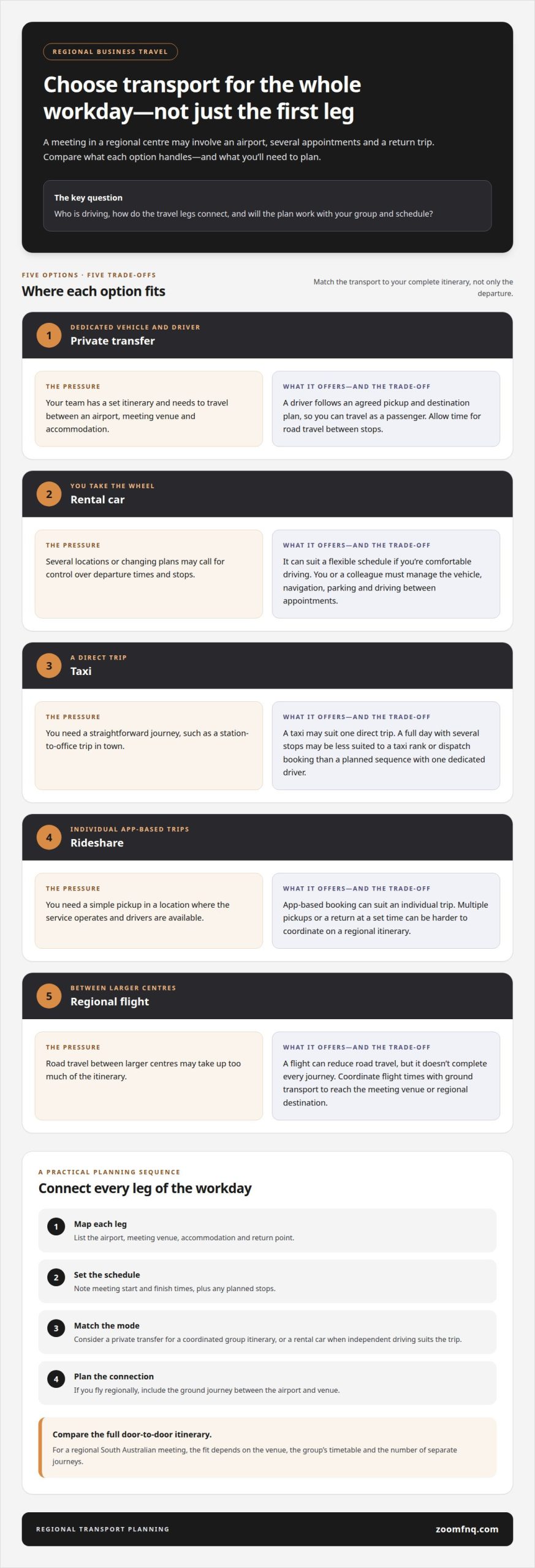
Picture a meeting in a regional centre, followed by another appointment elsewhere. Your transport choice affects who drives, how your itinerary connects, and how much attention you can give to work. A private transfer provides a dedicated vehicle and professional driver for your planned journey. Rental cars, taxis, rideshare and regional flights each suit different itineraries.
With a private transfer, the driver follows an agreed pickup and destination plan. You can travel between an airport, meeting venue and accommodation without driving yourself. For example, a visiting team can travel together with presentation materials and luggage. This suits a set itinerary, especially when everyone needs to arrive at the same venue. As the journey is by road, allow time between stops.
A rental car gives you control over departure times and stops. It can suit a traveller who is comfortable driving, has a flexible schedule and needs to visit several locations. However, you or a colleague must manage the vehicle, navigation, parking and driving between appointments. After flying into Adelaide, for example, driving onward to a regional meeting adds a task before the workday begins. Consider whether that responsibility fits your schedule.
Taxis can work for a direct trip, such as a station-to-office journey in town. They may be less suited to a full day with several stops, when you need transport to follow your meeting itinerary. A taxi rank or dispatch booking also differs from arranging one dedicated driver for a planned sequence. For a single appointment near a transport hub, a simpler option may be enough.
Rideshare can provide app-based booking for individual trips where the service operates. It may suit a straightforward pickup in a location with available drivers. A regional itinerary can be harder to coordinate if you need multiple pickups or a return journey at a set time. For instance, a meeting that finishes outside a town centre may require more planning than a city-to-office trip. Assess each leg separately.
Regional flights can reduce road travel between larger centres, but they don’t complete every journey. You may still need ground transport from the airport to a meeting venue or regional destination. That means coordinating flight times, airport transfers and onward road travel. For a meeting outside the airport city, compare the entire door-to-door itinerary, not just time in the air.
Use these practical steps to compare your options:
- Map each leg: list the airport, meeting venue, accommodation and return point.
- Set the schedule: note meeting start and finish times, plus any planned stops.
- Match the mode: consider a private transfer for a coordinated group itinerary, or a rental car when independent driving suits the trip.
- Plan the connection: pair a regional flight with ground transport when the venue is beyond the airport.
For example, a team attending a regional South Australian meeting could compare a direct road transfer with flying to a larger centre and arranging onward travel. The better fit depends on the venue, the group’s timetable and the number of separate journeys. A single city appointment may suit a taxi or rideshare, while several scheduled stops may favour a planned transfer.
Choose the option that fits the full workday, not just the first departure. If driving would distract you, a private transfer lets you travel as a passenger. If your plans change often, independent transport may offer more flexibility. For regional business travel, compare how each option connects your arrival, appointments and return journey.
Which Australian operators provide private transfers between major cities and regional business centres?
Private transfers in Australia are typically arranged around a route, not a single national network. Operators may focus on a capital city, an airport corridor or a regional area. For example, a journey from Adelaide to a business meeting in Mount Gambier involves road travel between localities. Start by matching the operator’s service area to your complete itinerary.
Three operator types are relevant for regional business travel:
- Chauffeur and private transfer operators arrange a dedicated vehicle and driver for a booked itinerary, such as an airport pickup followed by a regional meeting.
- Charter operators provide private road transport for groups, with the vehicle and trip planned around passenger numbers, stops and luggage.
- Local regional transport operators focus on journeys within a particular region, such as travel between a regional airport, town centre and nearby business locations.
These categories can overlap. A chauffeur business may serve airport trips and corporate journeys, while a charter operator may focus on group travel. The label alone won’t tell you whether the service covers your route. Ask what journey the service is designed for, then compare it with your pickup, destination and any stops.
Route coverage matters more than an operator’s city address. A Sydney-based business name doesn’t establish service to Dubbo, just as an Adelaide address doesn’t establish service to Whyalla. Identify the departure point, meeting location and return destination first. Then match each leg to an operator serving those locations.
For a trip involving several towns, split the itinerary into practical sections. For instance, a traveller flying into Adelaide and continuing to a regional South Australian meeting needs to coordinate airport pickup and onward road travel. One operator may cover the full route; another may handle only one leg. A clear itinerary helps identify the arrangement that fits.
Use these points to assess an operator’s fit:
- Route: name the exact origin and destination, such as Brisbane and Toowoomba.
- Journey type: explain whether you need an airport pickup, a direct transfer, or multiple scheduled stops.
- Passengers and luggage: provide the group size and describe any presentation equipment or oversized luggage.
- Timing: share flight details, meeting start time and required arrival time.
- Return plan: state whether the driver needs to collect you after the meeting or travel to another destination.
These details help distinguish a one-off transfer from a charter itinerary. They also make it easier to spot a gap, such as a regional destination beyond an airport operator’s usual route. For a group travelling from Melbourne to a meeting outside Bendigo, clarify whether the arrangement includes the road journey beyond the city or regional transport hub.
Don’t treat a provider directory or broad service description as proof of route coverage. Consider the actual journey: pickup, destination, stops and timing. Regional business centres across Australia vary widely in their connections to capital cities. A transfer plan that works for Geelong may not suit a meeting in a more distant regional town.
The most useful operator is the one whose service matches your itinerary and passenger needs. Compare the full journey, not just the departure city. Once the route is clear, you can plan how early to arrange transport for your meeting.
How far in advance should private transport be booked for regional business meetings
Book once your meeting date, route and travel times are settled. There isn’t one lead time that suits every regional journey. A direct trip between an airport and one venue needs less coordination than a multi-stop itinerary. For example, a team travelling from Adelaide to a meeting outside the city must plan the road journey around its arrival and start time.
The main principle is simple: give the operator time to plan the complete itinerary. A regional route can involve long road legs, limited pickup points and several appointments. Leaving arrangements until the schedule is nearly fixed can narrow the options for your preferred pickup time or vehicle type. Early planning also gives you time to coordinate transport with flights and accommodation.
Start with these booking factors:
- Route: identify every pickup, destination and planned stop.
- Schedule: share the meeting start time, finish time and required arrival time.
- Passengers: confirm who is travelling and whether the group will arrive together.
- Luggage: include presentation equipment or oversized luggage when describing the trip.
- Connections: allow for airport transfers or other travel legs in the itinerary.
For a single meeting in Ballarat, a direct transfer may be straightforward to schedule. A trip across regional Victoria with stops in Ballarat and Bendigo needs more coordination. The route, waiting time and return leg all depend on the order of appointments. Send the full schedule together rather than arranging each leg separately.
Flight details are especially useful for an airport pickup. Include the arrival airport, airline, flight number and landing time in your itinerary. If a colleague arrives on a separate flight, include those details too. This gives the transport plan a clear pickup point and helps align the road journey with the meeting schedule.
Dates can also affect planning. A meeting during a public holiday period or major local event may coincide with busier travel arrangements. If the date is fixed, plan transport as part of the event schedule. If the meeting date is flexible, settling it before finalising other travel details can make coordination easier.
When plans change, share the updated details promptly. A new venue, delayed flight or added appointment can alter the route and pickup sequence. For instance, moving a meeting from a town centre to an industrial site may change the drop-off point. Keep one current itinerary so the organiser and transport provider are working from the same information.
Use this order when organising a regional trip:
- Confirm the meeting date, venue and arrival deadline.
- Set the route, including airport and accommodation pickups.
- Gather passenger, luggage and flight details.
- Arrange transport against the complete itinerary.
- Share any schedule or destination changes as they occur.
For private transport for regional business meetings in Australia, the right booking window depends on the route’s complexity, date and schedule certainty. An early, clear itinerary gives the operator useful information for planning. Start once the meeting details are firm, then keep the travel plan current as arrangements develop.
Zoom FNQ
Zoom FNQ is a family-owned business offering private transfers and small-group travel for business trips in Far North Queensland. Its professional-driver transfers may be available for journeys connecting Cairns Airport, Palm Cove, the Atherton Tablelands and Mission Beach. Confirm your destination and travel details with Zoom FNQ before booking, as availability may vary. The service may suit meeting itineraries in these locations when you need driver-included transport rather than self-drive hire.
For an airport arrival, a pre-booked transfer can form the ground-transport part of your schedule. If your appointment is in Palm Cove, for example, ask whether a transfer can connect your arrival with that destination. A meeting in the Atherton Tablelands or Mission Beach calls for a different regional route. Check that your destination can be accommodated when deciding whether Zoom FNQ suits your plans.
Zoom FNQ offers private transfers rather than shared shuttles. That distinction can matter when a business group is travelling with work materials or needs a dedicated vehicle for its party. The company also offers small-group travel, which may suit colleagues attending the same meeting. Include your group’s needs when arranging the journey so the transport plan reflects who is travelling and where they need to go.
Destinations to ask about include:
- Cairns Airport: ask about pre-booked airport transfers for your Far North Queensland itinerary.
- Palm Cove: ask about travel for business appointments or accommodation in this destination.
- Atherton Tablelands: ask about regional meetings requiring travel beyond Cairns.
- Mission Beach: ask whether a private transfer to or from this destination can be arranged.
Zoom FNQ states that vehicle availability for pre-booked journeys is 24/7; confirm that a vehicle is available for your requested date, time and route when booking. This is not an on-demand or walk-up service. Arrange the transfer in advance, and provide the details that shape the journey: the pickup location, destination, preferred timing, passenger numbers and any luggage that needs to travel with you. For an airport journey, include the relevant flight details. These details give the booking a clear basis.
When you’re planning a meeting, consider the service in relation to the whole working trip. A transfer can be useful when you want a professional driver to handle the road journey while you travel as a passenger. If colleagues are travelling together, a small-group option may help keep their transport coordinated. For a destination outside the locations listed above, ask Zoom FNQ whether it can accommodate your journey before making arrangements.
Zoom FNQ’s family-owned service provides private transport with a professional driver in Far North Queensland. For example, a business traveller arriving at Cairns Airport and continuing to a regional appointment can ask about a pre-booked transfer for that route. The service is for driver-included travel, not rental vehicles or shared rides. Keep your meeting destination and transport arrangements aligned as you plan.
If your business trip includes one of these destinations, contact Zoom FNQ to discuss your planned transfer.
Frequently Asked Questions
What private transport options are available for regional business meetings in Australia?
Common choices include a chauffeur-driven private transfer or a private charter for colleagues travelling together. A transfer suits a defined journey, while a charter can be arranged around a broader work schedule. Your organisation’s travel policy may also shape the choice, particularly if employees need separate bookings or expense records. Consider whether colleagues need to travel together or independently before choosing an arrangement.
Can private transport include airport pickups, multiple stops, and return trips?
Yes, multiple stops can be part of a planned private journey. Clarify whether the driver is expected to wait during appointments or whether each leg should be treated as a separate trip. That distinction can affect the day’s schedule. For example, a brief stop to collect a colleague differs from waiting through a long meeting. Set out the intended arrangement when booking, including any changes to the sequence.
What should businesses check when booking private transport in regional Australia?
Before confirming, read the booking confirmation and the provider’s terms for changes, cancellations and missed pickups. Check that the confirmation reflects the agreed travel date and pickup instructions, and identify who will coordinate with the driver on the day. For a team booking, nominate one organiser to manage updates and share final instructions with passengers. This helps prevent colleagues relying on different versions of the arrangements.
What are the risks of relying on private transport in regional Australia, including long distances and limited availability?
Road journeys take time between stops, and an operator may not cover every leg of a regional route. Confirm the pickup, destination, stops and return plan with the operator, and allow enough road travel time in your schedule.
Related posts



Leave a Comment