
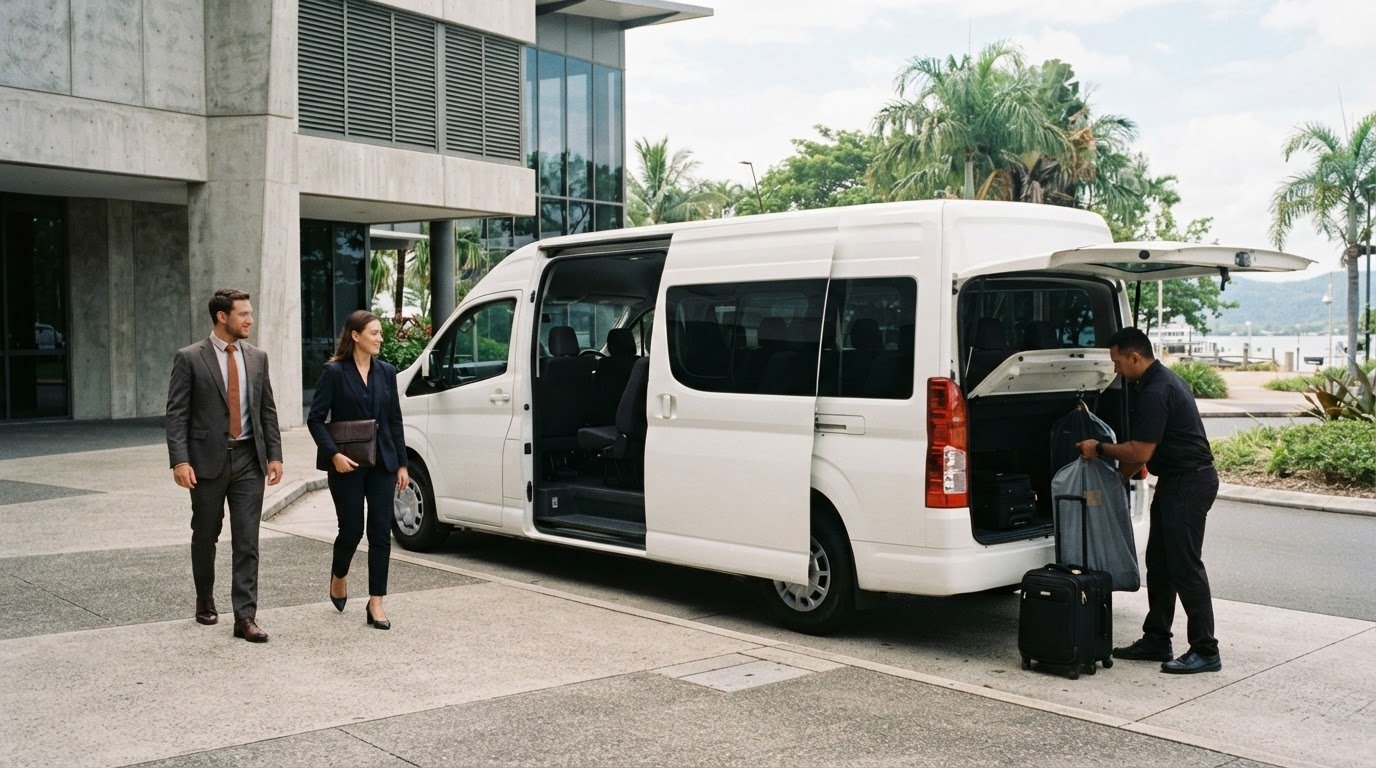
Can a chauffeur stay available between meetings, or will your transport end at the first drop-off? It depends on the booking arrangement and itinerary. Choosing executive ground transport for business travellers in Australia means matching the vehicle and service plan to your schedule, passengers and luggage, including any time between appointments.
A smooth business journey takes more than a comfortable cabin. You need a professional driver, a pickup arranged in advance and a service that understands the practical details of corporate travel. Thoughtful planning can make airport arrivals and guest transfers feel composed rather than rushed.
This guide explains how to choose a vehicle, assess corporate service experience and arrange hospitality transfers. You’ll also learn what to consider when checking coverage across Australian cities and regional destinations, so your transport plan fits the trip from arrival to final drop-off.
Key Takeaways
- Match the vehicle to your passenger numbers, luggage and itinerary so everyone can travel comfortably.
- Share flight and pickup details, plus your full schedule, to help coordinate airport arrivals and multi-stop journeys.
- Set out passenger preferences and hospitality arrangements in advance, while keeping sensitive meeting information private.
- Check that the transport plan covers the Australian city and regional destinations on your itinerary.
- Understand how pre-booked private transport differs from taxis, rideshare and shared shuttles before choosing what suits the trip.
Choosing a professional executive transport provider to match passengers and luggage
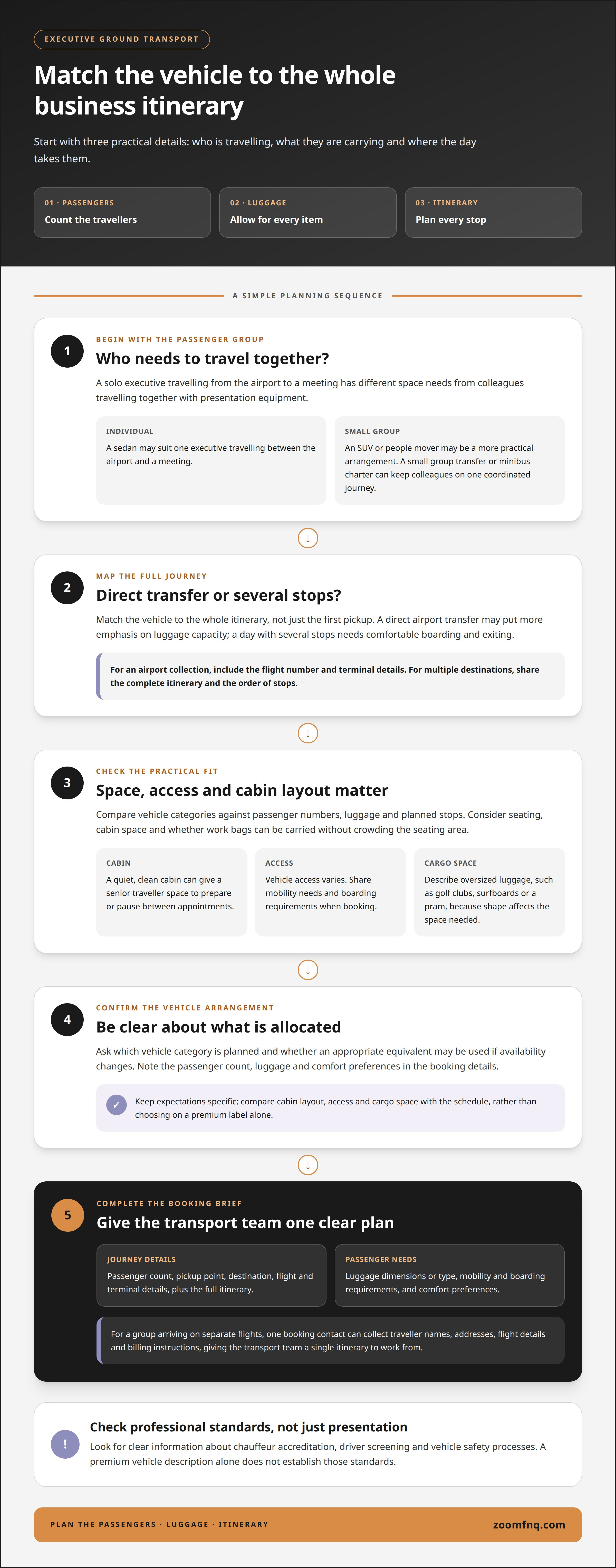
Start with the passenger count, luggage and itinerary, then match each to a suitable vehicle. For executive ground transport in Australia, the right arrangement also considers driver professionalism and passenger safety.
Vehicle options for individuals and groups
A sedan may suit an executive travelling alone between an airport and a meeting. For a small group, an SUV or people mover may offer a more practical arrangement. Choose based on passenger numbers, luggage and planned stops, not appearance alone.
A two-person airport pickup with carry-on bags has different space needs from a team travelling with presentation equipment. Include passenger numbers and the complete itinerary when booking. For colleagues travelling together, a small group transfer or minibus charter can keep the group on one coordinated journey.
Consider how the vehicle supports the day’s plan. A journey with several stops needs room for passengers to board and exit comfortably, while a direct airport transfer may put more emphasis on luggage capacity. Match the vehicle category to the whole itinerary.
Fleet amenities and passenger comfort
Premium comfort is practical as well as visual. Consider seating, cabin space and whether passengers can settle in with their work bags without crowding the seating area. A quiet, clean cabin can help a senior traveller prepare for a meeting or take a pause between appointments.
Ask what vehicle category is allocated and whether an appropriate equivalent may be used if availability changes. This matters when the itinerary depends on a particular amount of space or a consistent experience for visiting guests. Keep expectations specific: note the passenger count, luggage and any comfort preferences in the booking details.
Vehicle categories differ in cabin layout, access and cargo space. For a group travelling together, compare these practical features with the schedule rather than choosing on a premium label alone.
Accessibility and luggage capacity
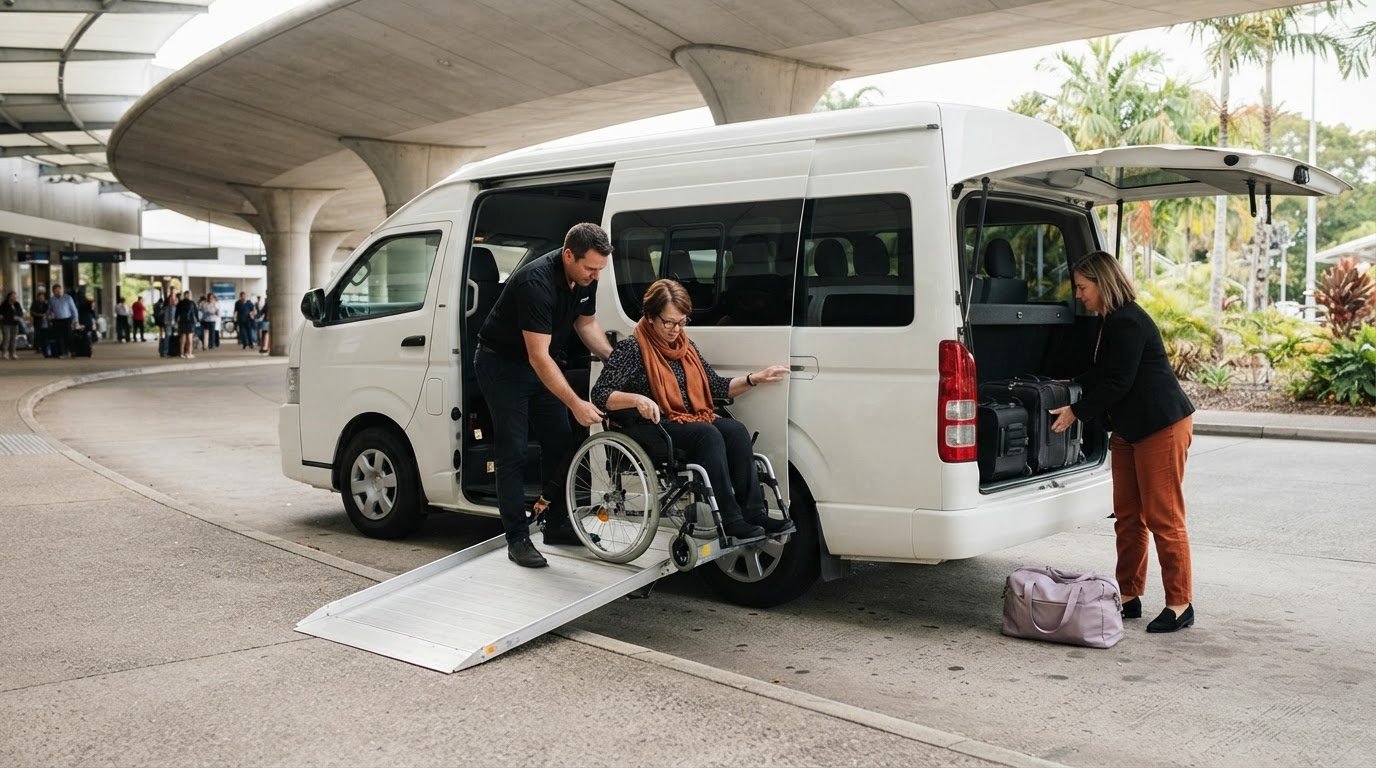
Access varies by vehicle, so share any mobility needs and boarding requirements when booking. The vehicle should suit the passenger’s way of boarding and travelling; a premium finish alone does not establish accessibility. For oversized luggage, describe the items, such as golf clubs, surfboards or a pram, because their shape affects cargo space.
Executive transport can accommodate mobility needs or oversized luggage when the vehicle and arrangement suit the passenger and items being carried. Share relevant details when booking so the plan accounts for boarding, seating and cargo space.
Professionalism also includes how a provider handles safety and driver standards. Look for clear information about chauffeur accreditation, driver screening and vehicle safety processes, rather than relying on a premium vehicle description. For an airport-to-office trip, consider whether the driver and vehicle arrangements support a calm, well-managed transfer from pickup to arrival.
Corporate transport experience and service history
Corporate travel depends on clear coordination, from airport collection to the final meeting address. A professional arrangement should account for the itinerary, passenger details and company travel procedures.
Corporate transport experience
A provider’s experience shows in how it handles the details of a business itinerary, not just vehicle presentation. Consider how airport arrivals, multiple destinations and schedule changes will be coordinated. For example, a visiting executive may need airport collection, a meeting stop and a later transfer to accommodation. Sharing the complete itinerary helps plan the sequence and pickup arrangements.
For an airport transfer, provide the flight number and terminal details to help coordinate the arrival. A chauffeur provides transport but does not replace security arrangements made by your company. Keep those responsibilities distinct in the corporate travel plan.
Coordinating multi-passenger corporate travel
For a group arriving on separate flights, nominate one booking contact to collect traveller names, addresses, flight details and billing instructions. This reduces conflicting updates and gives the transport team a single itinerary to work from. Include each passenger’s pickup point and destination, especially when colleagues have different meeting locations.
For a corporate group travelling together, set out passenger numbers, luggage needs and the order of stops. If meeting times change, an updated itinerary helps clarify which pickups or addresses are affected. The booking arrangement should also identify who can communicate schedule changes for the group.
Duty of care and traveller safety
Australian corporations have a legal and ethical duty of care to employees during work-related travel. A corporate transport plan can support that responsibility by recording journey details, passenger contacts and agreed pickup arrangements. It does not replace your organisation’s wider safety procedures.
Consider how the transport provider communicates driver and vehicle details, manages passenger collection and handles itinerary changes. For a late-arriving employee, clear pickup instructions can reduce uncertainty at the airport. Keep internal security protocols separate, and share only the travel information needed to deliver the journey.
Booking, airport collection and service risks
Airport pickup zones, parking and passenger collection arrangements vary between Australian airports and terminals. Follow the designated pickup instructions for the airport and terminal, and give travellers a clear meeting point. For a booking, provide passenger names, flight number, terminal, pickup address, destination and the full itinerary. These details help coordinate collection and any additional stops.
Incomplete flight information, late itinerary changes and unclear cancellation terms can complicate corporate travel. Before confirming transport, understand how changes and cancellations are handled. Booking arrangements should also set out the expected service, schedule and billing instructions, so the travel team can work from one clear plan.
For a planned airport journey, use the online booking details to share the trip information in one place.
Client hospitality and executive transfers
A guest’s first impression can begin before they reach the meeting room. Plan the journey around the client’s arrival, pickup point and next appointment. An executive arriving before a morning presentation, for example, may value a calm, direct transfer. Clear coordination helps the transport service support the visit without adding uncertainty to a full schedule.
Hospitality is personal, so record passenger preferences when arranging a transfer. Some clients prefer a quiet cabin to prepare for meetings; others may welcome conversation. Include a preferred contact method and clear pickup instructions. These details help the driver provide a considerate experience without assuming every guest wants the same interaction.
Keep the itinerary discreet. Share addresses, pickup times and details needed for the journey, but leave sensitive meeting notes out. A board agenda, negotiation position or confidential project information does not help coordinate a transfer. Limiting shared information to transport requirements supports privacy while giving the driver practical instructions.
Before finalising the booking, set out the vehicle category, pickup arrangement and contact method. Include extra stops, expected waiting time and any toll or parking arrangements. A guest visiting a client site before heading to a hotel, for example, needs both addresses and the intended stop order. Specific instructions reduce confusion at handover.
For a longer or multi-stop journey, provide the expected schedule, addresses and approximate waiting periods. This lets the transport team plan around the itinerary rather than treat each leg as an unrelated trip. If a meeting runs late, promptly share the revised schedule. One nominated person should send updates to keep communication clear.
Comfort also matters between appointments. A senior leader travelling for business four to five times per week may recover several productive hours each month by working during transit. That possibility depends on the day’s schedule and the traveller’s preference. A quiet cabin may suit preparation, while a restful break between meetings may be more useful.
For annual corporate travel planning, note recurring needs such as airport arrivals, guest preferences and common meeting locations. Use these details to shape a consistent hospitality approach, while tailoring each booking to the individual. A visiting speaker, for example, may need a different pickup and communication plan from a returning executive who knows the venue.
Australian city and regional coverage
A national itinerary can combine a capital-city meeting with a regional destination, so map each journey leg before arranging transport. Coverage means more than naming cities: consider airport transfers, meeting addresses, passenger handovers and the final regional drop-off. For example, a traveller might arrive in Sydney, attend a city meeting, then continue to a regional location. Each leg needs a clear pickup point and destination.
Start with the full itinerary. List every city, airport, address and planned stop, then group journeys by location and timing. In Sydney, allow for building entry, reception, security screening and finding the meeting room when setting pickup times. A vehicle arriving at the kerb does not remove those steps. Clear timing helps passengers reach the right entrance without rushing from the drop-off.
Regional travel needs a different kind of coordination. Distances between destinations, the location of the pickup and the number of stops all shape the plan. A journey from Cairns towards Port Douglas differs from a transfer continuing to the Atherton Tablelands or Mission Beach. Provide the exact address for each stop, rather than relying on a suburb or destination name alone. This gives the transport team a workable route and helps keep the day’s schedule coherent.
For travel across Australia, separate the itinerary into service areas instead of assuming one transport arrangement covers every leg. A corporate account may need city transfers in one location and a regional provider for another part of the trip. Identify who coordinates each leg, who updates passengers and how schedule changes are shared. That division is especially useful when colleagues arrive on separate flights or travel to different meeting venues.
Before confirming the plan, check that each pickup and destination sits within the intended coverage area. Include regional addresses, airport terminals and any return journey in the same itinerary. For instance, a passenger landing in Cairns may need transport to Palm Cove, then a later transfer towards Port Douglas. Treat each movement as a separate leg, even when the same passengers travel throughout.
Match transport to the purpose of each trip. A one-off airport arrival needs a clear collection plan; a multi-day visit may involve several addresses and changing meeting times. Set out those details early and make sure every passenger knows where to meet the driver. This helps connect the journey across different locations without assuming identical coverage everywhere.
Executive car services vs taxis & rideshare in Australia
Choose transport by the journey, not by the label. A taxi, rideshare, chauffeur service or airport shuttle can each suit a different trip. For a scheduled executive arrival in Cairns, the key distinction is whether you need a vehicle arranged around your itinerary or a ride at the time you request it.
A taxi can suit a straightforward trip, such as travelling from a hotel to one meeting. Rideshare offers an app-based way to request a journey and may suit a traveller with a flexible schedule. Pickup arrangements depend on the location and trip. If an executive must meet a waiting delegation, a pre-booked transfer can make the handover easier to plan.
A chauffeur service or private transfer is arranged in advance around the passenger, destination and schedule. This can suit a flight arrival followed by an office meeting and another stop. Share flight details, terminal and the full itinerary so the transport plan reflects the journey. A professional chauffeur provides dedicated transport but does not replace company security arrangements.
An airport shuttle usually involves shared transport, other passengers and possible additional stops. That may suit a traveller with a flexible schedule and one destination. A private transfer is for one party and can suit colleagues travelling together or a guest with a fixed appointment. Consider whether passengers need direct routing, privacy or a simpler arrival arrangement.
Compare the options against practical needs:
- Timing: A fixed meeting start may favour arranging pickup details before travel.
- Passengers: A group may need one vehicle plan rather than separate individual rides.
- Luggage: Oversized luggage, such as golf clubs or a pram, affects vehicle suitability.
- Stops: A multi-address itinerary needs the stops communicated in advance.
- Accountability: Confirm who holds the booking details and communicates schedule changes.
For an airport arrival in Far North Queensland, a pre-booked private transfer can align the pickup with your destination and travel party. A shared shuttle may be less suitable if the schedule depends on a direct journey. The choice is not that one option suits every traveller; it depends on timing, passengers, luggage and required stops.
If your trip begins at Cairns Airport, book Cairns Airport Transfers with your flight and destination details.
Zoom FNQ
Zoom FNQ provides professional corporate transport solutions as part of a broader network supporting business travellers across Australia. If your national itinerary includes operations, meetings or corporate transfers in Far North Queensland, choose private travel arrangements that fit your schedule. Share your pickup point, destination, flight details and any planned stops when booking. This gives your journey a clear structure, whether you are welcoming a visiting executive or coordinating logistics for colleagues.
As a family-owned provider, Zoom FNQ delivers expert local knowledge for corporate itineraries throughout the Cairns region and beyond. Discuss your national travel requirements with the team to coordinate your transport.
Contact Zoom FNQ to arrange executive ground transport for your next Australian business trip.
Plan your next business journey with confidence
Ground transport shapes the impression your business makes before a meeting begins. A well-planned journey can give you space to settle into the day and arrive ready to focus, rather than carry travel uncertainty into the room. Treat the transfer as part of the experience for colleagues and guests, not simply the gap between two addresses.
For your next business trip, consider what a composed arrival looks like for you and your fellow travellers. A calm start can set a thoughtful tone, whether you’re welcoming a guest or attending an important appointment. Choosing transport with that purpose in mind helps make the journey feel intentional.
When you’re ready to put that plan into motion, arrange your next journey with Zoom FNQ.
Frequently Asked Questions
Can a chauffeur stay available between meetings?
A booking can include a chauffeur waiting between appointments, depending on the arrangement. This may help when you have a short meeting break and want to avoid arranging another pickup. For a longer gap, consider whether keeping a vehicle and driver assigned is practical for your day. Agree on the waiting period and how changes will be communicated before travel.
What vehicle should I book for visiting executives?
Choose a vehicle that suits the visitor and the journey. Consider how easily they can enter and exit, whether they’ll carry presentation materials and whether the vehicle is appropriate for the event. A visiting director attending a formal function may have different needs from a colleague travelling to a casual site visit. Include specific access or comfort requirements when booking.
What executive ground transport options are available for business travellers in Australia?
Options include taxis, rideshare, pre-booked chauffeur services, private transfers, shared airport shuttles and group charters. The right fit depends on your organisation’s travel policy and the level of coordination the trip needs. A traveller with a flexible schedule may prefer an on-demand option, while an event organiser may need transport coordinated for several guests. Check that the option fits the journey and booking process.
Which Australian executive transport providers offer corporate accounts and business travel services?
Zoom FNQ offers corporate travel solutions. A corporate travel service and a corporate account are not necessarily the same: an account may include centralised booking administration or consolidated billing. Distinguish the transport itself from how bookings are authorised and reconciled. A travel coordinator can align the booking method with internal approval and expense processes, keeping trip records consistent for finance.
Are Australian executive transport providers required to hold licences, insurance and accreditation?
Requirements can depend on the jurisdiction and type of passenger transport, so there is no single rule for every Australian service. A company’s “executive” label does not establish its licensing or insurance position. For corporate procurement, identify the operator and driver requirements relevant to the service, then document how your organisation evaluates licensing, insurance and any accreditation it requires.
What features should business travellers look for, such as flight tracking, meet-and-greet and invoice billing?
Look for features that make the journey easier to manage after booking. If a service offers flight tracking, confirm how changes to flight status affect pickup timing. A meet-and-greet arrangement should explain how the passenger will identify the driver. For invoice billing, check whether the record captures the details your finance team needs, such as the traveller, trip date and business reference.
Related posts


Leave a Comment